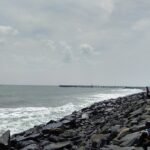
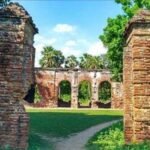
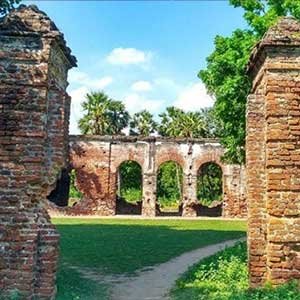
Tucked along the banks of the Ariyankuppam River, just a few kilometers south of modern-day Pondicherry, lies the remarkable archaeological site of Arikamedu—an ancient port city that once thrived as a global trading post nearly 2,000 years ago. With its roots in Tamil and Roman history, Arikamedu serves as a quiet testament to the early cultural and commercial exchanges between South India and the Mediterranean world.
🌍 Historical Significance
Arikamedu is believed to have been a thriving port city between the 2nd century BCE and the 8th century CE, with its peak during the 1st century BCE to 2nd century CE, when Roman influence was at its strongest. It was identified as the port of Poduke (or Poduca) in the ancient Greco-Roman text Periplus of the Erythraean Sea.
Key Civilizations That Touched Arikamedu:
- The Cholas and early Tamil kingdoms
- Roman Empire (evident from imported amphorae, glassware, and coins)
- Later French and colonial settlers, who reused some ruins for building materials
🏺 Archaeological Discoveries
The site gained global attention after excavations led by Sir Mortimer Wheeler in the 1940s. His findings unveiled:
- Roman pottery: Especially Arretine ware and amphorae used to carry wine and olive oil
- Bead-making units: Arikamedu was a key exporter of glass and semi-precious stone beads
- Brick structures: Suggesting warehouses, dwellings, and wharfs
- Coins and ceramics: Linking it to trade with Rome, Greece, and Southeast Asia
More recent excavations by the ASI (Archaeological Survey of India) and international archaeologists have confirmed that Arikamedu was a multi-layered site with continuous habitation and cultural transitions.
🔍 Cultural & Trade Insights
Arikamedu was not just a commercial port but also a cultural melting pot. Tamil traders, Roman merchants, and local artisans interacted here, fostering:
- Bilingual trade practices (use of Tamil-Brahmi and Latin)
- Exchange of textiles, spices, gems, and ivory for Roman luxury goods
- Early influences of Greco-Roman art and architecture in South India
Artifacts from Arikamedu have even been displayed in museums in India and abroad, shedding light on a forgotten but vital Indo-Roman connection.
🏞️ Visiting Arikamedu Today
Though much of Arikamedu lies in ruins, its open landscape and historical energy attract:
- History enthusiasts and archaeologists
- Photographers fascinated by ancient brick walls and riverside views
- Spiritual seekers exploring early cross-cultural contact zones
Practical Details:
- Location: Ariyankuppam village, ~7 km from Pondicherry center
- Entry: Free (no formal ticketing), open to the public
- Best Time: Early mornings or post-monsoon, when the river is full and foliage lush
- How to Reach: Take the Cuddalore road; local auto or bike rental ideal
🧭 Xplore Pondy Tips:
- Bring a guidebook or historian if you want deeper context
- Carry water and wear walking shoes (terrain is uneven)
- Combine with a visit to Chunnambar Boat House for a cultural + leisure combo
🔗 Legacy
Arikamedu may no longer echo with the clang of traders or scent of ancient spices, but it remains a crucial chapter in India’s maritime legacy. As globalization finds new forms today, Arikamedu reminds us that the roots of international exchange were planted long ago—on these very shores. #Arikamedu #XplorePondy #IndoRomanTrade #AncientPortsIndia